Author Archives: admin

Bloom Festival expecting large crowds

This year Bloom, in conjunction with Dublin City Council and the Environmental Protection Agency (EPA), has taken major steps in ‘greening’ Ireland’s largest garden festival. This initiative is part of the EPA’s National Waste Prevention Programme.

The Bloom festival takes place over the June Bank Holiday – Thursday 29th May to Monday 2nd June with an expected audience in the region of 120,000 coming to Phoenix Park over the weekend.

Last year, a large amount of festival waste was recycled, with remaining waste being converted to energy. This meant that nowaste from Bloom 2013 was sent to landfill.

This year a major step in extending its green credentials will be ensuring that food waste and packaging will be composted. All food vendors will be using certified compostable packaging.  As a result, all food service packaging will be commercially composted and used in landscaping.

To ensure Bloom 2014 is as waste friendly as possible, this year we are introducing a three bin system, to allow segregation of waste by visitors at the festival. There will be 1 bin for food and compostable packaging waste, 1 bin for recyclables and 1 bin for general waste.

Green ambassador volunteers will be assisting and discussing recycling/composting and food waste prevention to members of the public throughout the festival

Bloom 2014 – Show Garden

In Ireland over 1 million tonnes of food waste is disposed of per year. On average 1/3 comes from homes, which means that each person is throwing away 80kg of food waste per year. This is the weight equivalent of 80 bags of sugar needlessly discarded per person per year. Food waste is a real problem and is costing Irish householders on average €700 each year. Most of our wasted food ends up in landfills where it has significant local environmental impacts.

2014 is the European year against Food Waste and to coincide with this programme, Dublin City Council, in conjunction with the EPA has commissioned a ‘waste garden’ at Bloom 2014. The main focus of this garden must be on food waste prevention, recycling and composting of food and garden waste.

This is the national launch of the programme which will be rolled out across the country throughout the remaining part of the year.


Conservation plan launched for Merrion Square Park

SONY DSC


The Lord Mayor Oisín Quinn launched a Conservation and Management Plan for Merrion Square Park at the Irish Architectural Archive, Merrion Square, yesterday.

The Plan is a comprehensive study of the historical development of the ‘garden’ of Merrion Square from its beginning as a private garden to being one of the most important public parks and spaces in our City today.

“The focus of the Merrion Square Park Conservation Study is on the conservation, preservation, protection and management of this wonderful Square at the heart of the South Georgian Quarter. Many challenges lie ahead including maintaining a high level of service to the many visitors to the park but there are also many exciting new possibilities” said the Lord Mayor.

The Plan recommends how the historical integrity of the Park can best be conserved for the future and considers what future changes would be appropriate to interpret the heritage of this wonderful Square and also to accommodate first class visitor facilities.

The Conservation and Management Plan for Merrion Square Park can be viewed here.


Art work returned to The Hugh Lane

2 - Barbara Dawson Director Dublin City Gallery The Hugh Lane

Barbara Dawson Director of the Hugh Lane beside the artwork.

Dublin City Gallery The Hugh Lane together with Criminal Assets Bureau is delighted to announce the return of In the Omnibus by the French artist Honoré Daumier (1808 – 1879). This beautiful drawing in watercolour and gouache was stolen from the Gallery in 1992 and recovered by CAB late last year. In the Omnibus is part of the original collection presented by Hugh Lane to Dublin for the Gallery of Modern Art which first opened to the public in 1908.


“We are delighted to have In the Omnibus returned” says Barbara Dawson director of the Gallery. “It was such a shock when it was stolen and we had messages of sympathy from galleries and museums in Ireland and around the world.  We are very pleased to have it on exhibition again for all our audiences to enjoy. Daumier is a very significant artist whose powerful realism and social consciousness continues to have relevance today. Our congratulations and thanks to the members of CAB for their outstanding detective work in finding In the Omnibus”.


“The Criminal Assets Bureau wishes to thank the Hugh Lane Gallery for their kind words of appreciation.  The Bureau is particularly pleased that as part of its investigative work in 2013, this significant piece of artwork has been recovered and restored to the gallery, having been stolen in 1992. I wish to express my congratulations to the Bureau Officers involved in the investigation and in particular to Detective Garda Philip Galvin whose investigative work led directly to the recovery of this piece of artwork” said Detective Chief Superintendent Eugene Corcoran, Chief Bureau Officer, Criminal Assets Bureau.


Survey shows that economic woes still important

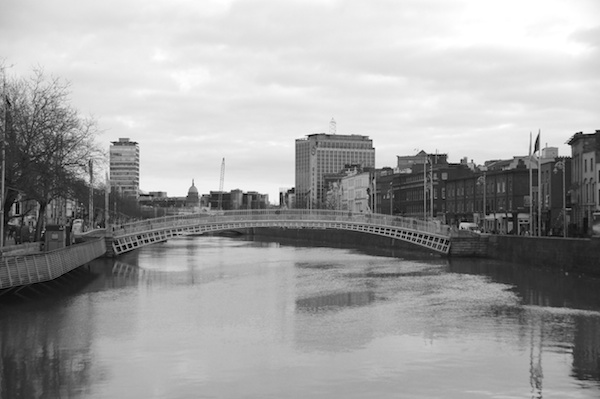
TDR The Liffey


The most recent Your Dublin, Your Voice survey asked citizens how they are managing to get by at the moment. How do they feel about their personal financial situation and how confident are they in economic recovery? What level of interest is there among people in starting a business? And what issues do people intend to raise with local election candidates on the doorsteps?

Carried out in December 2013 some 1,417 people responded to the latest Your Dublin, Your Voice survey, Getting on in Dublin. Although 92% of respondents were Irish, 37 other nationalities completed the survey.

YDYV found that while some 55% of respondents felt more confident about the state of the Irish economy compared to one year ago, a similar proportion (53%) actually indicated that they personally were, in fact, worse off financially than last year. Furthermore over one third of respondents expected to be worse off next year. Financial pressure was the biggest worry for 42% of respondents, followed by work / job security (17%) and health (13%). Half of people had family or friends who had to emigrate in the last 4 years because they could not find suitable employment

The top four topics people wished to discuss with local election candidates were employment, the national economy, public transport and water. A further 176 respondents mentioned accountability of public servants and representatives and political reform as issues to raise with local election candidates.

Women, people aged 46 – 65 and those with dependent children feeling less confident and more worried; younger age groups feeling brighter about the future.

Those aged 46 – 65 and those with dependent children felt that their personal financial situation was worse than one year previously with 46 – 65 year olds most likely to describe themselves as feeling ‘angry’ about the state of the Irish economy
18 – 30 year olds were most likely to feel ‘hopeful’ about the economy and to anticipate better personal financial health in one year’s time.

Just under half of all respondents indicated that the recession had had a major negative impact on their finances – one from which they had not yet recovered. Again this was especially true for those aged 46 – 65 years and those with dependent children.

A majority (85%) worry a bit or a lot about their household finances, with more women than men and more people with dependent children than more likely to indicate that they worry a lot.

Some 63% of respondents rated their children’s quality of life as better than their own when they were a child

However, mothers are more likely than fathers to feel that their children’s quality of life is not as good as theirs was as a child and women feel that their own quality of life is worse than that of their parents at the same age.

Men were more likely than women to consider starting up a new business, as were those aged 18 – 30 and those without dependent children.

36% of respondents indicated that they relied on family or friends to meet some day to day living needs with women and people with dependent children more likely to do so.

48% of YDYV respondents indicated that they provided regular financial or in-kind assistance to family or friends in a vulnerable financial situation; those over age 65 were more likely to be providing this kind of assistance to others.

Just 18% of respondents indicated that they would consider setting up a new business in the next 1 – 2 years. This proportion was higher among men, those aged 18 – 30 years and people who did not have dependent children.

Art in Parks

SONY DSC

Art in Parks, a new guide to sculpture in Dublin City Council Parks is now available to view here.

The guide explains the story behind over thirty pieces of sculpture and has descriptions on the work, the artists and the parks where they are situated. It is hoped that with this information the experience of visiting city parks will be enhanced as well as promoting the creative arts in the city.

The guide includes the popular Oscar Wilde sculpture that is made of coloured stone from different countries as well as the more hidden abstract Adult and Child Seat located in St Catherine’s Park.

“Visiting the city’s parks offers an opportunity to experience some of Dublin’s most historic and contemporary public spaces while engaging with some of the city’s rich and exciting collection of public art. I hope this guide makes these sculptures more accessible and enjoyable to all who visit these parks” said Kieran O’ Neill, Senior Executive Landscape Architect in Dublin City Council.

UN Human Rights Day honour for Václav Havel

Tomorrow 20 December 2013 at 12 noon, Lord Mayor Oisín Quinn will dedicate a living memorial bench at St. Patrick’s Park to the playwright, dissident and Czech president Václav Havel. The Lord Mayor will be joined at the ceremony by His Excellency Mr. Tomas Kafka, Ambassador of the Czech Republic, Professor Borek Sipek, friend of Havel and renowned architect and designer of the memorial, and Karel Schwarzenberg, politician and close adviser to Havel.

The memorial called “Václav Havel’s Place” was designed by Borek Sipek and comprises two seats intertwined around a lime tree, the national tree of the Czech Republic. The idea behind the memorial bench is to create a meeting space for democratic discussion and to encourage freedom of speech. The first “Václav Havel’s Place” was unveiled in Washington in October 2013 and Dublin is the second city to honour Havel in this way. Dublin’s sister city Barcelona proposes a similar memorial for 2014.

The Lord Mayor Oisín Quinn said: “I am delighted and honoured to dedicate this living memorial bench to the great and inspirational Václav Havel. St. Patrick’s Park is a fitting and contemplative setting for “Václav Havel’s Place” as it complements the “Literary Parade” which honours many world renowned Dublin writers such as Jonathan Swift and Samuel Beckett. Indeed Beckett dedicated a work called “Catastrophe” to Havel. I hope this memorial will stimulate not only Dublin citizens but the many visitors to this park, to chat, dream and develop ideas. I would like to thank Dublin City Council, H.E. Mr. Tomas Kafka, and the Czech Embassy, Bill Shipsey and the friends of Havel for their generous gift to this city.”.

H.E. Mr. Tomas Kafka, Ambassador of the Czech Republic said:” For any Czech citizen, let alone a representative of our country; it is a great honour to be associated with the legacy and example of our late President Václav Havel. I am very grateful to Bill Shipsey of Art for Amnesty, Dublin´s Lord Mayor Oisin Quinn as well as several Irish friends of Vaclav Havel, including the support of Skoda Ireland, that, thanks to their generosity, we can unveil “Václav Havel´s Place”, for Czechs better known as “Václav Havel´s bench”, on Human Rights Day in Dublin. This bench symbolizes Václav Havel´s fondness for dialogue and communication as one of the crucial foundations for a kinder and more tolerant society. I wish to dedicate to this new monument in Dublin a slogan as unpretentious as President Havel himself: “Let´s hope the world may change/ on Václav Havel´s bench”

Bill Shipsey, Art For Amnesty said: “It is a proud day for Amnesty International and the cause of universal human rights for which Vaclav Havel dedicated his life, that Dublin is dedicating the first ‘Havel’s Place’ in Europe and the first in a public space anywhere in the world in his honour. Vaclav Havel came to Dublin 10 years ago to receive the inaugural Amnesty International ‘Ambassador of Conscience’ Award from the hand of Seamus Heaney whose poem inspired the Award. We remember both Seamus and Vaclav on this proud day.”

“Václav Havel’s Place” memorial was funded by Dublin City Council, H.E. Mr. Tomas Kafka, Ambassador of the Czech Republic and the Czech Embassy, Skoda Ireland, Bill Shipsey and the Friends of Václev Havel. The lime tree was provided by SAP Nurseries.

New set up in St Stephen’s Green

New right turn from St. Stephen’s Green East to Merrion Row

Two right turning lanes from St. Stephen’s Green East to Merrion Row will become operational from tomorrow, Tuesday 26 November 2013. The right turns will be operational for tomorrow’s evening rush hour.

The right turning lanes provide access to the Northside of the city via Merrion St Upper and access to the N11 via Baggot St. The works are part of the St. Stephen’s Green Area Traffic Management Scheme. This scheme will facilitate the Luas Cross City works.

When construction of Luas Cross City commences on St Stephen’s Green West, St Stephen’s Green North and Dawson St, there will be a reduction in the capacity for vehicular traffic on Dawson St. Due to this it is necessary to provide alternative arrangements for traffic in the area.

A new right turn from St. Stephen’s Green South to St. Stephen’s Green West opened on Thursday 21 October. This provides an alternative route to York St and access to the St. Stephen’s Green / Grafton St car parks.

Francis Bacon exhibition of photos of Freud opens tomorrow

Dublin City Gallery The Hugh Lane is delighted to announce a display of material relating to Lucian Freud drawn from Francis Bacon’s archive and studio which is located in the Gallery.  The significance of this exhibition is that items on display relate  to the recently auctioned painting at Christie’s, New York of ‘Three Studies of Lucian Freud 1969’ by Francis Bacon.  The painting sold last night at a record price of $142.4m, – €104m.


The material, relating to the triptych, (three paintings in one), includes a heavily manipulated photograph of Lucian Freud seated on a bed.  This photograph taken by John Deakin in the 1960’s, is manipulated by Bacon in advance of painting. The photograph is deliberately torn with the corner folded, so that Freud’s left leg is obscured. The fold is fixed with paper clips as was a practice of Bacon’s and the paint marks on the photograph indicate that Bacon consulted the photograph during the painting process.


“Lucian Freud was a significant figure in Francis Bacon’s life during the 1950s and 60s and he is the subject of some of Bacon’s most memorable paintings. We are very fortunate to have the archive of Francis Bacon in the Hugh Lane as it is a unique resource which relates directly to his artworks and adds an immense amount of information on Francis Bacon and his art” says Barbara Dawson, director.


Francis Bacon and Lucian Freud were friends in the 1950s and 60s and over 60 images of Lucian Freud were discovered in Francis Bacon’s Studio which is now located in Dublin City Gallery The Hugh Lane. A display of images of Lucian Freud including photographs by John Deakin commissioned by Francis Bacon will go on exhibition in the Gallery on 14 November 2013.


Olive tree to be dedicated to twin city

On Monday 11 November 2013 at noon, the Lord Mayor of Dublin Oisín Quinn will formally dedicate a 300 year old olive tree situated in Cow’s Lane to the City of Barcelona.   Deputy Mayor of Barcelona Jaume Ciurana and Bill Shipsey, who donated the tree to the City of Dublin, will also be in attendance.

Lord Mayor Oisín Quinn said:- “It is a great honour for me to dedicate this olive tree to the City of Barcelona.  The Cities of Barcelona and Dublin are twin Cities since 1998, and we in Dublin are happy to mark the 300th anniversary of the Siege of Barcelona, a very important time in the history of our sister city.  It is also dedicated to the cause of human rights which is a cause strongly promoted by Bill Shipsey through his global artist engagement programme, Art for Amnesty.”

Deputy Mayor of Barcelona Jaume Ciurana said:- “I am extremely grateful for the dedication of this three hundred year old olive tree to my city, Barcelona, and to human rights.  With this simple event we are two cities committed from today to extending the cause of freedom and Human Rights.”

The 300 year old olive tree was donated by Bill Shipsey to the City of Dublin in 2006 and it has been situated in Cow’s Lane since then.  He donated an olive tree as a symbol of human rights and as a living testament to man’s desire for freedom.

 [googleMap name=”Cow’s Lane Dublin” description=”Cow’s Lane” width=”300″ height=”300″]Cow’s Lane Dublin[/googleMap]